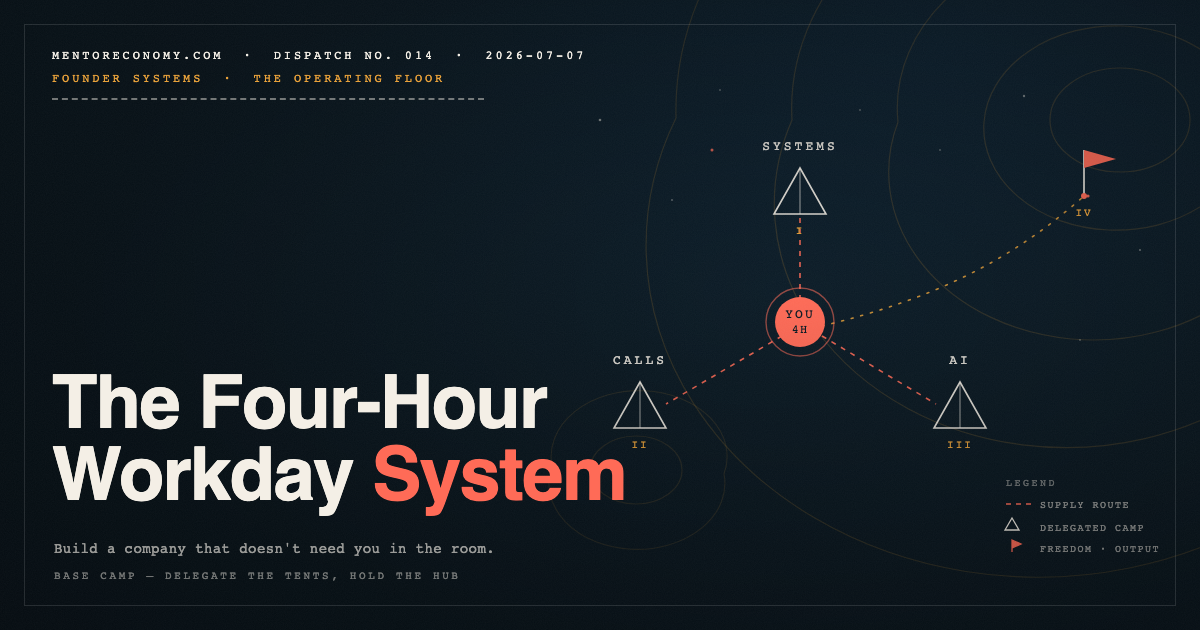
Four-Hour Workday Business Systems: How to Build a Company That Doesn't Need You in the Room
The four-hour workday isn't about doing less. It's about building a business that runs on systems instead of on you — and the time-use research says the hours you'd be cutting were mostly never productive in the first place.
A four-hour workday is achievable because most of a standard workday was never productive: knowledge workers average 2 hours 48 minutes of productive task time per day, employees spend 57% of their time communicating about work instead of doing it, and business owners burn roughly a third of a 45.5–49.4 hour week on admin and email. The fix is four systems — communication, content, delivery, decisions — built on documented processes, which the strongest causal research shows raise productivity (+11% in a randomized field experiment) while letting owners delegate. This dispatch is the manual; the playbook dispatch is the story of living it. A 15-minute self-audit is at the bottom.
Most advice about working less treats it as a lifestyle choice — a nice-to-have for people who've already made their money. I treat it as a design constraint, and this dispatch is the manual for building to it. (The story of why I build this way — twenty-three years of Crohn's disease capping my reliable hours at about four a day — is a separate dispatch, The Four-Hour Founder Playbook. Read that one for the sorting exercise and the constraint research. Read this one for the machine itself.)
Here is the position I'm going to argue: the four-hour workday is not an ambitious productivity target. It is approximately what a normal workday already contains, minus the waste. The eight-hour day most founders defend is mostly a container for repetition, interruption, and administration — and the data on this is remarkably consistent across three very different measurement methods.
The hours were never there to begin with
Start with direct measurement. RescueTime's analysis of 185 million hours of anonymized working-time data found knowledge workers average just 2 hours 48 minutes of productive task time per day. The rest of screen time went to neutral activities (1h 6m) and outright distracting ones (1h 12m). That is not a motivational statistic. It is a measurement of where the eight-hour container actually leaks.
Telemetry at much larger scale says the same thing from a different angle. Microsoft's Work Trend Index — 31,000 people across 31 countries plus Microsoft 365 usage data — found the average employee spends 57% of their time communicating (meetings, email, chat) and only 43% creating. Sixty-eight percent say they don't get enough uninterrupted focus time in a workday, 62% lose time just searching for information, and the heaviest users spend 7.5 hours a week in meetings and 8.8 hours a week on email. Inefficient meetings ranked as the number one productivity disruptor.
And for owners specifically — the people who supposedly can't step back — the picture is worse, not better. A Time etc survey of 251 US entrepreneurs found the average owner works a 45.5-hour week and spends 36% of it on small administrative tasks — logging expenses (59% do this weekly), research (49%), schedule management (45%), invoicing (44%), data entry (43%). Ninety-nine percent do admin work themselves. The Alternative Board's survey of 323 business owners adds the strategic cost: owners average 49.4 hours a week, spend roughly a third of it on email and web browsing, and spend only about 32% of their time working on the business — while 73% say that's what they'd prefer to prioritize.
Sources: RescueTime State of Work Life Balance (185M hours of tracked time); Microsoft Work Trend Index 2023 (31,000 workers, 31 countries); Time etc entrepreneur survey (n=251); The Alternative Board owner survey (n=323).
Put those four studies side by side and the conclusion is hard to avoid. The founder "working" fifty hours is typically doing something like three to four hours of judgment work, buried inside forty-plus hours of communication overhead, information-hunting, and admin. The four-hour workday doesn't cut the productive core. It cuts the burial.
Why documented systems are the mechanism, not a nice-to-have
The obvious objection: fine, the waste exists, but doesn't removing the owner just move the waste onto someone (or something) else? This is where the strongest evidence in this entire subject lives, and it's causal, not correlational.
In a randomized field experiment on large Indian textile firms — Bloom, Eifert, Mahajan, McKenzie and Roberts, "Does Management Matter?" — plants that adopted structured management practices, including documented standard operating procedures for quality, inventory, and maintenance, raised average productivity by 11% in the first year. Just as important for our purposes: the documented processes enabled owners to delegate more decisions to middle managers. That is the closest thing the research literature has to a controlled test of "write the system down and the business needs you less" — and it passed.
The follow-up work scaled the finding. Using the US Census Bureau's survey of roughly 35,000 manufacturing plants, Bloom, Brynjolfsson and colleagues found that variation in structured management practices explains about one-fifth of the entire productivity spread between plants — a similar share to R&D, and twice what's explained by IT investment. Read that again in founder terms: the documented process matters twice as much as the software you run it on. Founders chronically get this backwards, buying tools (the Time etc respondents had plenty of apps) while leaving the process in their heads.
This is the same conclusion I reached the practical way, and it's the spine of my book on the subject:
"The Founders who succeed long-term in any industry are not the ones with the most knowledge. They are the ones who built systems around their knowledge. The system is what compounds. The knowledge is what feeds the system."
The four systems, in build order
Everything a business does falls into two categories: work that requires your specific judgment, and work that's repeatable enough to systemize. The four-hour day is what's left when the second category runs on systems. These are the four, ordered by how much owner time each typically recovers.
1. The communication system
Microsoft's 57%-communicating figure is the target here. Most of what fills a founder's day is answering the same handful of questions repeatedly — and 62% of workers separately report losing time hunting for information that should have been findable. The system: your own material (FAQs, past answers, your frameworks) wired to answer common inbound questions automatically, with clear escalation to you for anything genuinely unusual. Done well, clients get faster and more consistent answers than an overworked founder could give them, and the escalations that do reach you are the ones that actually need judgment.
2. The content system
Producing the material that attracts and teaches your audience used to cost hours of personal time per piece. A content system captures your thinking once — a recorded conversation, rough notes, one good explanation — and turns that raw material into multiple finished pieces. The deeper version of this, training a system on your own voice and frameworks so the first draft sounds like you, is its own build; I've written it up in the AI clone dispatch. The pattern the book teaches is the same for any workflow: build a first-pass assistant, test it on three real examples, feed your edits back until editing takes under ten minutes.
3. The delivery system
Whatever you sell — a course, a program, a service — needs documented structure that delivers value on schedule without you personally pushing every piece forward. This is the direct application of the SOP research above: the Indian-textile finding was precisely that documented procedures let the operation run and improve with the owner making fewer of the daily calls. It's also usually the difference between a business that scales and one that plateaus at exactly the number of clients the founder can personally handle.
4. The decision system
The part that stays entirely human, on purpose: a short, protected list of decisions that genuinely require your judgment — pricing, hard client calls, strategic direction. TAB's survey found owners spend only about a third of their time on this kind of work while 73% wish they could prioritize it; the first three systems exist to hand this system its hours back. If you suspect your judgment itself is the underpriced asset here, that argument has its own dispatch.
The 15-minute self-audit
You don't need a week of time-tracking to start (though the full sorting exercise in the playbook is worth the week). Run this against last week, from memory, right now:
Minutes 1–3: List your last ten working days' recurring tasks. Just the ones that appeared three or more times. Email triage, invoicing, scheduling, status updates, first-draft anything, answering "what's included?" for the fourth time.
Minutes 4–6: Mark each task J or R. J = needed your judgment specifically. R = repeatable; a documented process or an assistant with your materials could have done a passable first pass. Be ruthless: "it's faster if I do it" is an R.
Minutes 7–9: Estimate weekly minutes per R task. Rough is fine. The survey benchmarks say your R pile should land somewhere near a third of your week; if yours comes in under 20%, re-check your J calls.
Minutes 10–12: Circle the single largest R task, then write its process down as numbered steps. However far you get in three minutes. If you can't write the steps, that's the finding — the process lives only in your head, which is exactly the condition the plant research says costs the most.
Minutes 13–15: Assign the circled task to one of the four systems (communication, content, delivery, decisions — if it's genuinely decisions, it stays with you) and put one calendar block this week on building that system's first version, not on doing the task again.
That circled task is your entry point. Not all four systems at once — one system, around the biggest repeatable leak, until it runs without you. Then the next.
Cross-ref · Ledger
This dispatch is the manual. The full framework — the week-by-week version of the audit above, the workflow documentation method, and the AI first-pass build — is the book The Bottleneck Is You, from the same library as The Mentor Economy. Details on the press page.
What a four-hour day actually looks like once the systems run
It is not four relaxed hours. It is four hours of concentrated, high-judgment work — the decision system's protected list — while the other three systems handle communication, content, and delivery in the background all day. Which is to say: it looks almost exactly like the 2 hours 48 minutes of productive time RescueTime already measured inside everyone's eight-hour day, plus a margin — except now it's the whole day, on purpose, and the business is built to know the difference.
A business that only works because its founder puts in twelve hours a day isn't really a business — it's a very demanding job with better branding. A business that runs well inside four focused hours has real, documented systems underneath it. The research says those systems are worth about a fifth of the entire performance gap between businesses. The four-hour day is just what it feels like to be on the right side of that fifth.
FAQ
Isn't a four-hour workday just a productivity gimmick?
Not as used here. It's a design constraint that forces you to build systems instead of relying on personal effort. The time-tracking data suggests most knowledge workers only get about 2 hours 48 minutes of genuinely productive time per day anyway — the four-hour day just makes that fact explicit and builds the business around it.
What's the first system I should build?
Whatever repeats the most and requires the least judgment. Survey data on entrepreneurs shows admin work — logging expenses, invoicing, scheduling, data entry — eats about 36% of a 45.5-hour week, and 99% of owners do it themselves. Start with the biggest repeat offender on your own list, usually first-contact communication or admin.
Is there real evidence that documented systems let a business run with less of the owner in it?
Yes. A randomized field experiment on Indian textile firms found that adopting documented standard operating procedures raised productivity 11% in the first year and let owners delegate more decisions to managers. A US Census study of ~35,000 plants found structured management practices explain about 20% of the productivity gap between businesses — twice what IT explains.
Won't clients notice and feel shortchanged?
Clients notice quality and responsiveness, not how many hours you personally worked. A well-built system usually responds faster and more consistently than an overworked founder ever could — and the hours it frees go back into the judgment work clients are actually paying for.
Filed by
Italo Campilii
Author of The Mentor Economy and co-founder of MentorMe. He writes about turning hard-won expertise into AI-leveraged one-person businesses.