TL;DR — what the evidence says before you start:
- The administrative bar is nearly zero: a one-person US business with no registration is a sole proprietorship by default (IRS), and the Census counts you as a business at $1,000 in annual receipts (Census Nonemployer Statistics).
- The outcome distribution is steep: 75.5% of the 30.4 million US one-person businesses took in under $50,000 in 2023; 11.2% topped $100,000 (2023 Nonemployer Statistics).
- Experience is the visible sorting variable: coaches with 10+ years average $69,721 annually versus a $49,283 global average (2025 ICF Global Coaching Study).
- You do not need an audience. The average active coach practitioner works with 12.4 clients and coaches 11.6 hours a week (same study).
- The market is genuinely growing: 27.6 million Americans now work independently full-time, up from 13.6 million in 2020 (MBO Partners, 2025 State of Independence).
Almost every "how to become a solopreneur" guide is written backwards. It opens with logistics — pick a name, register an entity, build a site, choose a niche — because logistics are easy to write about and produce the feeling of progress. Then it ends with "and get clients," which is the only part that was ever hard.
This one runs in the order the work actually happens, and attaches the relevant numbers so you can calibrate. Where the evidence contradicts the standard advice, I've said so.
Step 0: understand what you're joining, honestly
The one-person economy is real and large. The US Census Bureau's 2023 Nonemployer Statistics counts 30,427,808 businesses with no paid employees, generating $1.75 trillion in receipts. The Census Bureau's own analysis, The Steady Rise of the Nonemployer Business, shows they grew an average of 2.7% per year from 2012 to 2023 against 1.1% for employer businesses. This is a fifteen-year structural trend, not a pandemic artifact.
And most of it earns very little. Summing the receipts size classes in that same Census table: 75.5% took in under $50,000 for the entire year, and receipts are revenue, not profit. Only 11.2% topped $100,000. The distribution includes every hobby LLC and every side income, so it is not 23 million people failing — but it does mean the median outcome of "becoming a solopreneur" is a supplement, not a salary. I broke the full distribution apart in the solopreneur statistics field report.
Plan against that curve. It doesn't argue against starting; it argues against quitting anything in month one.
Step 1: the administrative part, which takes an afternoon
In the United States, if you sell something as an individual and don't register anything, you are already a sole proprietor — the IRS defines one as "someone who owns an unincorporated business by themselves," reporting profit or loss on Schedule C with Form 1040 and self-employment tax on Schedule SE. There is no application to file to begin.
What genuinely deserves an hour of professional attention rather than an article's opinion: whether an LLC makes sense for your liability exposure, what your state requires, and how to handle estimated quarterly taxes. Those are jurisdiction-specific and consequential. Everything else in the standard setup checklist — logo, business cards, brand palette, a five-page website — can wait until after someone has paid you, and most of it should.
If you want the vocabulary straight before you start, the definitions piece separates the legal category from the business model, and the glossary defines the rest.
Step 2: pick the problem, not the passion
The most common early mistake is choosing a topic instead of a problem. "Leadership" is a topic. "New engineering managers who just inherited a team they used to be a peer on" is a problem, and it has a buyer attached.
The advantage most people entering this work already hold is unglamorous and specific: years of accumulated pattern recognition in a narrow domain. MBO Partners counts 11.5 million independent service professionals in 2025 — up 55% since 2020 — which is the closest available proxy for expertise-based one-person businesses. That cohort is growing far faster than the overall independent workforce.
The experience premium shows up in the earnings data too. The 2025 ICF Global Coaching Study — 10,035 valid responses, conducted with PwC Research — reports that practitioners with more than ten years of experience average $69,721 in annual revenue against a global average of $49,283, and that Baby Boomer coaches average $60,323 versus $33,553 for Millennials, charging $270 per hour versus $193. Whatever else is true, the market pays for accumulated judgment.
The fear of choosing wrong is the thing that actually costs people years — I made that case in The Wrong-Niche Fear. Pick the narrow problem you have solved most often. You can widen later; nobody starts wide and survives.
Step 3: build the smallest sellable version
Not a course. Not a membership. Not a book. The first offer should be the smallest complete thing that solves the problem once, for one person, in a way you could deliver next week without building anything.
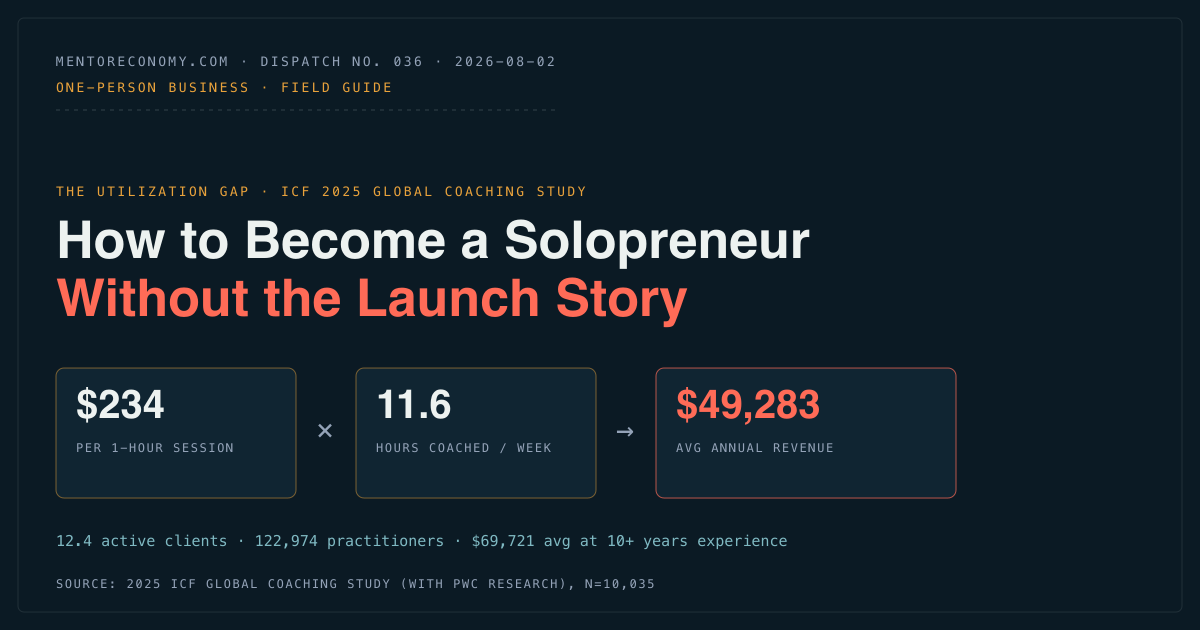
The scale required is smaller than most people assume. That same ICF study found active coach practitioners work with an average of 12.4 active clients and spend 11.6 hours per week coaching, at an average fee of $234 for a one-hour session. Twelve relationships. Eleven and a half hours. That is the shape of a functioning one-person practice — and it is why "build an audience first" is advice that describes a different business than the one you are starting.
Note the arithmetic in those three numbers, because it is the most useful thing in the study: $234 an hour is a strong rate, and $49,283 a year is a modest income. The gap between them is not price — it's utilization. Which is exactly why the second year of this work is about systems, not about raising rates. Once the smallest offer is proven, the sequence for turning one body of knowledge into several offers is in The Expertise Ladder.
Step 4: get the first paying client without an audience
This is the step every guide skips, and it is almost always solved the same way: the network you already have. Not a launch, not a funnel — a list of people who know your work, a specific description of the problem you now solve, and a direct conversation.
The obstacle at this stage is rarely traffic. It's credibility without a track record of paid engagements — the chicken-and-egg problem I worked through in The Proof Problem, and the concrete 30-day sequence is in Your First Paying Mentee.
Underprice the first two deliberately, then stop. Experienced people chronically undercharge for reasons that have nothing to do with market rates, which is its own subject in Pricing Your Expertise.
Step 5: convert the AI dividend into capacity, not leisure
Here is the lever that genuinely did not exist for the previous generation of solo practitioners. MBO Partners found 74% of independents used generative AI in 2025, up from 65% in 2024, and that it saves them an average of nine hours per week — 64% use it to automate repetitive work and 62% say it lets them expand what they offer clients.
Nine hours a week is roughly a quarter of the working week returned to a business whose entire capacity is one person's calendar. But the returns are not evenly distributed. Upwork's Future Workforce Index 2026 found freelancers doing AI work earn 34% more per hour, and earnings from complex AI work rose 45% year over year — while low-complexity generative AI execution work saw per-contract earnings fall 13%.
The tools raised the ceiling and lowered the floor at the same time. Which side you land on is decided by what you point them at: the delivery and admin layer around your judgment, or the judgment itself. The practical build is in The AI Leverage Stack and The 80/20 Delivery Layer.
What "successful" realistically looks like, on a timeline
No study tracks a cohort of new solopreneurs year by year, so anyone giving you a month-by-month revenue schedule is guessing. What the data supports is a shape, not a schedule:
- Year one is validation. A handful of paid engagements, delivered more than once, for people who were not friends. Not a full income.
- The middle years are utilization. The ICF numbers say the constraint is rarely your hourly rate — it is how few hours are billable. Systems, repeat clients, and productized offers move that; raising prices alone does not.
- The experience premium compounds late. The 10+ year cohort earning $69,721 against a $49,283 average is the honest picture of what patience buys.
And the ceiling is real: 117,060 US one-person businesses crossed $1 million in receipts in 2023, and MBO counts 5.6 million independents earning over $100,000 in 2025, up from 3 million in 2020. Rare is not the same as fictional. The structure of the businesses at that end is in the million-dollar anatomy, and the ideas that hold up under this data are in one-person business ideas.
Ledger cross-reference
This whole sequence — positioning, first offer, first client, the system that carries it — is what The Mentor Economy is. The book is free; you cover $9.95 shipping.
Get the book →Gaps in this evidence file
Logged for the record. There is no longitudinal dataset following new one-person businesses over time, so the "timeline" above is a shape inferred from cross-sectional experience cohorts, not a tracked cohort — treat it as directional. ICF's figures cover coach practitioners specifically, not all expertise businesses, and 80% of respondents were ICF members, which likely skews toward the more professionalized end of the field. Census receipts are revenue, not owner income, and lag by roughly two years. MBO Partners and Upwork are commercial firms whose business depends on independent work growing, which is a bias worth holding even where the Census trend corroborates the direction. Nothing here establishes causation between any single step and an earnings outcome.
What it does support: the barrier to entry is near zero, the median outcome is modest, the upper tiers are real and compounding, and the variable most visibly associated with higher earnings is accumulated experience — which, if you are reading this in your forties or fifties, is the asset you already have.