How to Monetize Your Expertise With AI (Without Selling Your Soul)
You don't need a new skill. You need a way to package the one you already have — and a system that delivers it without eating every hour of your day, or your integrity.
Name the one problem you solve — one sentence, one specific person, one specific outcome.
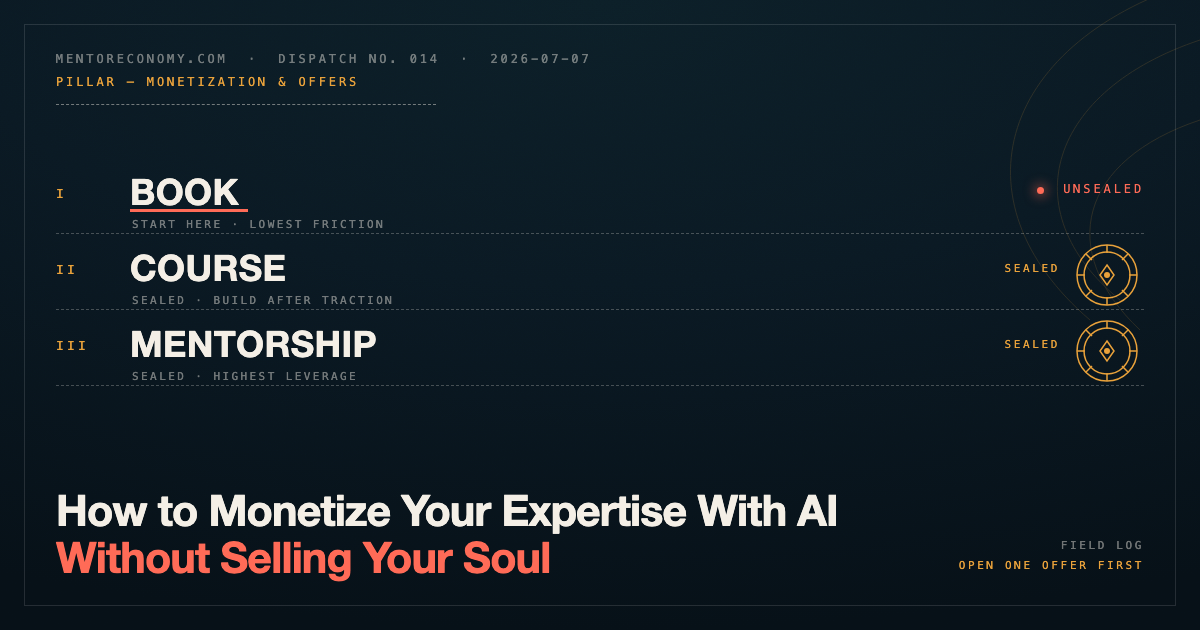
Book (or short guide) — a low-priced first offer that earns the first yes and builds your list.
Course — the same method, deeper, at a middle price, delivered mostly by systems.
High-touch mentorship — your direct judgment, for the few, at your highest price.
AI runs the repetition at every rung. You keep the judgment. That's the whole model.
Most people who've spent a decade or two getting good at something assume the way to monetize that expertise is to become a full-time creator, consultant, or coach — trading their time for money one client at a time. That's the hard, slow version. I've run the hard version. There's a faster one, and it starts with a reframe: you're not selling your time. You're selling a system, and AI is what lets that system reach people without you personally being in every conversation.
The demand is real, and it is measured
Before the how, the why-now. The market for packaged knowledge is not a hunch. Research and Markets values the global online education market at $382.53 billion in 2025, projected to reach $1.00 trillion by 2034 — an 11.32% compound annual growth rate. Goldman Sachs Research projects the creator economy's total addressable market roughly doubling from $250 billion to $480 billion by 2027.
But inside those same Goldman numbers sits the fact almost nobody quotes: of roughly 50 million global creators, only about 4% earn more than $100,000 a year. The market is enormous and most participants make almost nothing — because most participants are producing content volume instead of packaging expertise. The money is not in posting more. It's in structuring what you know into offers people can buy at increasing depth.
The one-to-one version has a measured ceiling too. The ICF Global Coaching Study 2025 (run with PwC Research, 10,035 valid responses) found active coach practitioners charge an average of $234 per session hour, work 11.6 coaching hours a week, serve 12.4 active clients — and earn an average of $49,283 a year. A record 122,974 coaches contributed an estimated $5.34 billion to the global economy, up 17% since 2023. Experience compounds pricing power: coaches with over ten years average $69,721 annually, and Baby Boomer coaches charge $270 per hour against $193 for Millennials. Respect the profession — but notice the shape of the math. Hourly expertise tops out where the calendar tops out. Packaged expertise doesn't.
Step 1: Name the specific thing you already know
Before any AI tool is useful, you need clarity on what you're actually teaching. Not your entire career — one specific, solvable problem you've solved more than once. "I know how to run a small manufacturing shop" is too broad to sell. "I know how to cut scrap rate on a production line by finding the three most common operator errors" is specific enough that someone with that exact problem will pay to skip the years it took you to figure it out.
The first rung of the ladder is a book or substantial written guide, and the reasoning is cold economics, not vanity. A book is the cheapest possible way for a stranger to buy a piece of your judgment. It removes the hesitation from the first transaction, it proves you can structure what you know, and — most importantly — it builds a list of people who have already paid you once.
That list matters more than the book revenue. Unbounce's 2024 Conversion Benchmark Report — 464 million unique visitors, 41,000 landing pages, 57 million conversions — found traffic arriving from email outperformed every other channel in nearly all industries, with ecommerce email traffic converting at a 28.6% median. The low-ticket entry offer exists to fill the email list; the email list is where the rest of the ladder gets sold. The same report found pages written at a 5th-to-7th-grade reading level convert at 11.1% — roughly double professional-register writing. Translation: the plain, honest version of your offer outsells the impressive-sounding one. That's convenient, because plain and honest is also the version you can defend.
This is where AI genuinely earns its place. Talk your process out loud, dump it into rough notes, then use AI to organize the raw material into steps and language a stranger can follow. AI is excellent at structure and clarity. It cannot manufacture the substance — that still has to come from your actual experience.
Step 3: Rung two — the course
Once the book is generating buyers and honest feedback, the course is the same method at greater depth: worked examples, templates, the decisions behind the framework. It's priced in the middle because it delivers more of your thinking without yet delivering your calendar. Delivery is mostly systems — a structured sequence of lessons, AI answering the common questions from your own material, flags raised when someone needs real attention. (The mechanics of that delivery layer are the subject of the four-hour workday systems dispatch.)
Step 4: Rung three — high-touch mentorship
The top rung is direct access to your judgment: a small group program or one-to-one mentorship, at your highest price, for the small number of people whose situation genuinely needs it. The ICF data shows why this rung holds premium pricing — experience visibly compounds what the market will pay for direct access — and the thought-leadership research shows how buyers arrive at it. The Edelman-LinkedIn 2024 B2B Thought Leadership Impact Report found 75% of decision-makers say a piece of thought leadership led them to research a product they weren't previously considering, 52% spend an hour or more per week reading it, and 9 in 10 are more receptive to outreach from its authors. Demonstrated practitioner expertise — the book and the course — is precisely what sells the mentorship. The rungs are not separate products. They're one relationship, deepening.
This is the model the book lays out in full, and it rests on a structural claim I hold as the core position of this dispatch: the losers in the next decade will not be the people with less knowledge. From Chapter Three of The Mentor Economy, "The Real Gap Nobody Names":
They are losing because they did not translate their expertise into a system, and the Founders who did are eating their lunch.
The "without selling your soul" part — name the patterns
Here's the truth this industry avoids saying: the reason "monetize your expertise" sounds slimy is that a visible slice of the industry earns the reputation daily. If you want the ladder without the stain, refuse these patterns by name:
Fake scarcity. "Only 3 spots left" on a digital product with infinite capacity. If the deadline isn't real, don't print it.
Manufactured urgency. Countdown timers that reset on refresh. Evergreen "closing tonight" sequences.
Income-claim marketing. Screenshot revenue with no costs, no timeframe, no verification — implying a typical result the 4%-earn-$100k data flatly contradicts.
Pain-looping. Deliberately agitating someone's fear or shame far past what's needed to explain the problem, so they buy from distress instead of judgment.
The ascension trap. Selling a thin product whose real content is a pitch for the next, more expensive product. Every rung must be complete and worth its price on its own.
Borrowed authority. "As seen in Forbes" from a paid placement; AI-generated testimonials; credentials implied but never held.
None of these are necessary. The Unbounce data above is the receipt: plain copy at a 7th-grade reading level converts at double the rate of impressive-sounding copy, and email to people who already trust you converts at 28.6%. Honesty is not the expensive option. It's the higher-performing one, and it's the only one that survives a decade of you being publicly attached to your own name.
What AI should and shouldn't touch
The dividing line for AI at every rung is the same: AI handles repetition, you keep judgment. Drafting, structuring, answering the questions you've answered a hundred times, sequencing lessons, flagging who needs attention — all AI. The client whose situation doesn't fit the framework, the hard call, the moment the standard advice is wrong — visibly, personally yours. That line is both the ethical boundary and the commercial one: your judgment is the only thing on the ladder competitors can't copy. (The full architecture for encoding your method into a system is in the AI clone dispatch.)
A note on pacing
Don't build the entire ladder before launching anything. Get one small, honest offer in front of real people early, then let their actual response tell you what to build next. A polished three-rung ladder no one has bought into is worth less than a single rung already generating real revenue and real feedback. And none of this works as a shortcut around actually having something to teach — AI accelerates the packaging of real expertise; it cannot fabricate the expertise itself. If you have real, hard-won experience, the opportunity is real. If you're hoping AI generates expertise from nothing, that's a different, much shakier business, and not the one I'm describing.
Cross-reference · Sign the log
The first rung of your own ladder starts free. Your Next Base Camp — the free course — walks you through naming your one-sentence method and packaging your first offer, step by step.
What if my expertise feels "boring" or too niche to teach?
Niche and specific is an advantage, not a weakness. The people who need your exact experience are searching for exactly that specificity — a generic answer already exists everywhere for free. Your specific years in your specific situation is what they can't get anywhere else.
What order should I build the offers in?
Book first, course second, high-touch mentorship last. The book is the cheapest thing for a stranger to say yes to, the course deepens the relationship at a middle price, and mentorship is reserved for the small group who want direct access. Each rung funds and validates the next.
Is it dishonest to use AI to help write or teach what I know?
No, as long as the judgment and experience are genuinely yours. Using AI to draft, organize, or explain your own real expertise is no different than using an editor or a design tool — the substance still has to be yours.
How much can I realistically earn?
The ICF Global Coaching Study 2025 puts the average individual coaching revenue at $49,283 a year at an average $234 per session hour — and coaches with over ten years of experience average $69,721. Packaged expertise (book, course, group offers) is what lifts income above the hourly ceiling, because it decouples revenue from calendar hours.
Filed by
Italo Campilii
Author of The Mentor Economy and co-founder of MentorMe. He writes about turning hard-won expertise into AI-leveraged one-person businesses.