TL;DR — what the data rewards, and what it doesn't:
- Fastest-growing nonemployer sectors 2022–23 were Accommodation and Food Services +6.4%, Transportation and Warehousing +5.3%, Utilities +5.1% — but Taxi and Limousine Service alone added ~122,000 establishments (US Census Bureau, July 2025). Growth in count ≠ a good business.
- Experience is the visible earnings variable: coaches with 10+ years average $69,721 vs a $49,283 global average (2025 ICF Global Coaching Study).
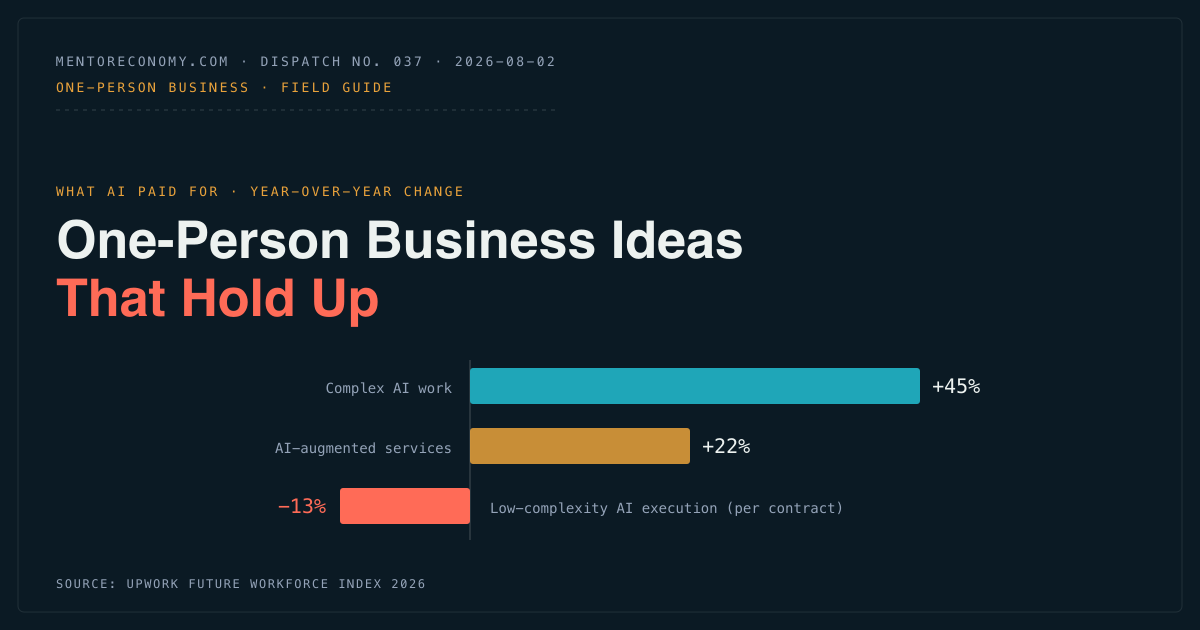
- AI pays for complexity and penalizes execution: complex AI work earnings +45% YoY, low-complexity AI execution −13% per contract (Upwork, Future Workforce Index 2026).
- The fastest-growing expertise segment: 11.5 million independent service professionals, up 55% since 2020 (MBO Partners, 2025 State of Independence).
- The ceiling is measurable: 117,060 one-person businesses crossed $1M in receipts in 2023 (2023 Nonemployer Statistics).
Search "one-person business ideas" and you get numbered lists — dropshipping, print-on-demand, newsletter, AI agency, digital products. They are written to be plausible, not to be true, and none of them are checked against a dataset. This is the version that starts with the data and refuses to name an idea until the filter is built.
First, the trap: growth in count is not opportunity
The natural instinct is to look for the fastest-growing category and go there. The Census Bureau publishes exactly that, and it is instructive — mostly as a warning.
In The Steady Rise of the Nonemployer Business (July 2025), the fastest-growing nonemployer sectors between 2022 and 2023 were Accommodation and Food Services (+6.4%, adding 40,234 establishments), Transportation and Warehousing (+5.3%, adding 202,407), and Utilities (+5.1%, adding 884). The single largest absolute gain at the three-digit industry level came from Transit and Ground Passenger Transportation — and within it, Taxi and Limousine Service added nearly 122,000 nonemployer establishments in one year, passing pre-pandemic levels for the first time.
That is platform driving. It is the largest, fastest-growing one-person business category in the United States, and it is the textbook example of a business where the operator owns no pricing power, no client relationship, and no asset that appreciates. Meanwhile Health and Personal Care Retailers lost 46,558 nonemployers (−13.5%) over the same period, and nonemployer receipts overall came in around $1.8 trillion, about 6.4% of GDP — down 0.4% from 2022.
So: category growth tells you where people are going, not where the returns are. A useful idea filter has to be built from earnings data instead.
The four tests an idea has to survive
Test 1: does it sell judgment, or execution?
This is the test the 2026 data made non-negotiable. Upwork's Future Workforce Index 2026 found freelancers doing AI work earn 34% more per hour, and earnings from complex AI work rose 45% year over year — while per-contract earnings for low-complexity generative AI execution work fell 13%. AI-augmented professional services grew 72% in volume with earnings up 22%.
Any idea whose core deliverable is "produce the artifact" — the copy, the graphic, the edit, the deck — is now competing with a tool that produces a passable version instantly. Ideas whose core deliverable is deciding which artifact is correct, for this client, in this situation are being paid more, not less. This is the whole argument of Sell Judgment, Not Time, and it now has a price attached.
Test 2: can one person deliver it repeatedly?
The constraint that defines this model is that there is no second person. An idea passes only if delivery can be systematized, productized, or handed to software — and fails if scaling revenue requires proportionally scaling your hours.
The 2025 ICF Global Coaching Study (10,035 valid responses, conducted with PwC Research) shows exactly why this matters. Active coach practitioners charge an average of $234 for a one-hour session — a strong rate — work with 12.4 active clients, spend 11.6 hours a week coaching, and earn an average of $49,283 a year. Do that arithmetic and the constraint is obvious: it isn't the rate, it's the utilization. An idea that only monetizes while your mouth is moving inherits that ceiling. The structural fix is in Four-Hour Workday Business Systems.
Test 3: does the buyer already have a budget line for it?
Ideas that require inventing a budget category are dramatically harder than ideas that redirect an existing one. Companies already spend on training, consulting, contractor capacity, and advisory. MBO Partners counts 11.5 million independent service professionals in 2025, up 55% since 2020, inside a total independent workforce of 72.9 million — that growth is enterprises moving existing spend toward independents, not new budget appearing.
Which is why the strongest one-person businesses I see sell into organizations rather than to individuals — the argument in Your Best Buyer Is Not a Person.
Test 4: does AI make this cheaper to deliver, or cheaper to replace?
MBO Partners found 74% of independents used generative AI in 2025, up from 65% in 2024, saving an average of nine hours per week; 62% say it lets them expand what they offer clients. That dividend is real — but it lands on both sides of the table. If a tool can shorten your delivery, ask whether the same tool lets your client skip you entirely. Ideas where AI compresses the work but the client still cannot evaluate the output without you are the durable ones.
What passes the filter
Applied honestly, the filter does not produce a trend list. It produces a shape, and the shape is the same one the million-dollar tier already occupies:
- Advisory built on a specific operating history — not "consulting," but the narrow function you ran for a decade, sold to organizations facing the problem you already solved. Passes all four tests when the domain is narrow enough that judgment is the product.
- Productized expert services — a fixed-scope, fixed-price engagement delivered the same way every time. This is the direct answer to the utilization problem in Test 2.
- Codified method, licensed or taught — your process turned into something a company or a practitioner can run without you in the room. The build is in How to Codify Your Knowledge.
- Fractional roles in a specialized function — passes Test 3 unusually well, because the budget line already exists and the alternative is an expensive full-time hire.
- AI-augmented delivery of an existing professional service — the category Upwork measured growing 72% in volume with earnings up 22%. The stack is in The AI Leverage Stack.
Every item on that list has the same precondition: you already know something specific and hard-won. That is not a coincidence in the data — it is the pattern. If you're wondering whether your particular twenty years qualifies, that's its own dispatch.
What fails the filter, and why it keeps getting recommended
Ideas that appear on every list and fail at least two tests: generic content or design services (Test 1 and Test 4), reselling access to a tool with no judgment layer (Test 1), anything whose only differentiation is price (Test 3), and any model whose revenue is strictly linear in your hours with no productization path (Test 2).
They keep getting recommended because they are easy to start, and starting is what idea lists optimize for. The Census distribution is the receipt: 75.5% of the 30.4 million US one-person businesses took in under $50,000 in 2023 receipts, and only 11.2% topped $100,000. A very large number of people started something easy. The full distribution is in the solopreneur statistics field report.
The ceiling, for calibration
117,060 US nonemployer establishments crossed $1 million in annual receipts in 2023 — including 905 above $5 million. And MBO Partners counts 5.6 million independents earning over $100,000 in 2025, up from 3 million in 2020. I took the structure of that top tier apart in the million-dollar anatomy; the through-line is that they sell judgment, deliver through systems, and sell into organizations — the same three tests, passed.
If you're at the earlier stage and want the sequence rather than the filter, start with how to become a solopreneur, and get the vocabulary straight in solopreneur vs entrepreneur vs freelancer.
Ledger cross-reference
Turning what you already know into an offer that passes all four tests is the entire subject of The Mentor Economy. The book is free; you cover $9.95 shipping.
Get the book →Gaps in this evidence file
Logged. No public dataset crosses one-person business receipts with business model or offer type, so the five shapes that "pass the filter" are inference from the earnings patterns — reasoned, but not measured. Census sector data counts establishments, not owners, and receipts are revenue rather than income, on roughly a two-year lag. The ICF figures describe coach practitioners specifically, with 80% of respondents being ICF members, so they likely skew toward the professionalized end. Upwork and MBO Partners are commercial firms whose businesses depend on independent work growing. And the Upwork complexity split — the single most load-bearing finding here — is correlational: complex AI work earning more is consistent with complexity being rewarded and with more capable operators taking complex work first.
What survives all of that: category choice matters far less than whether the idea sells judgment, can be delivered repeatedly by one person, targets an existing budget, and uses AI as an amplifier rather than as the product. Test your idea against those four before you spend a year on it.