TL;DR — the short version:
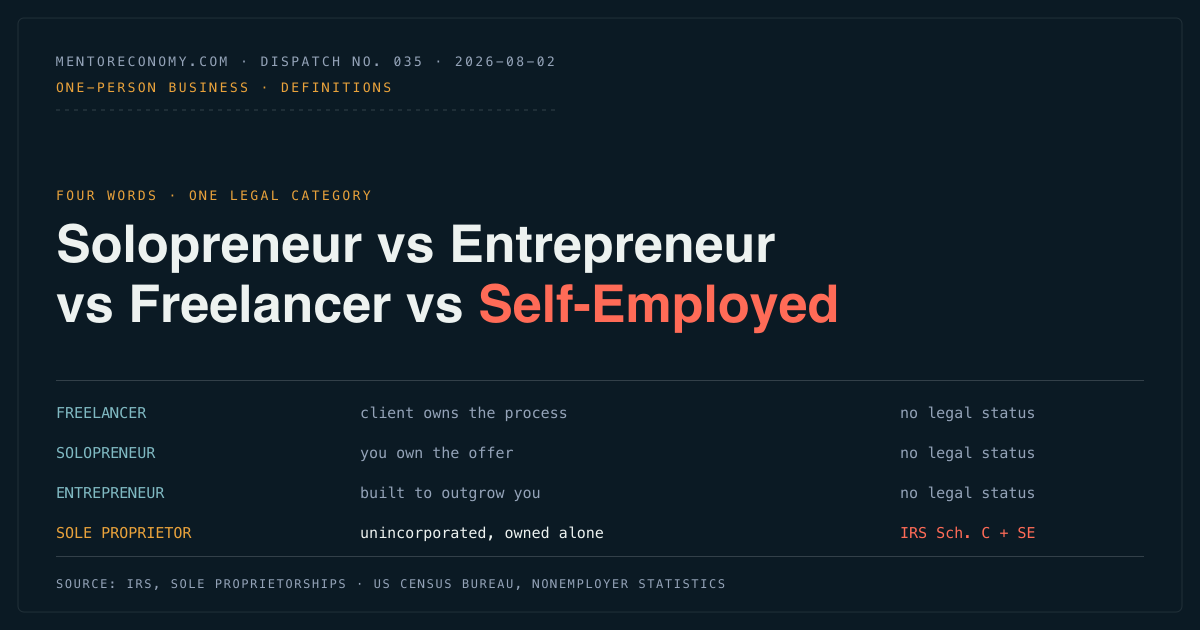
- Self-employed / sole proprietor is the only one of these terms with a legal definition. The IRS says a sole proprietor is "someone who owns an unincorporated business by themselves", filing Schedule C with Form 1040 and Schedule SE for self-employment tax.
- Freelancer describes who owns the process: the client does. You supply execution into someone else's plan.
- Solopreneur describes who owns the offer: you do. Capacity comes from systems and AI instead of headcount, and the business is designed to stay one person on purpose.
- Entrepreneur describes a business designed to outgrow its founder — headcount, capital, eventual handover.
- The label you pick changes nothing. The model you pick changes a lot: 75.5% of US one-person businesses took in under $50,000 in 2023, while 117,060 crossed $1 million (US Census Bureau, 2023 Nonemployer Statistics).
There are two completely different questions hiding inside "am I a solopreneur or a freelancer?" and almost every article on the subject answers neither cleanly. The first question is legal and administrative: what am I in the eyes of the tax authority, and what do I have to file? That one has a hard answer. The second is strategic: what kind of business am I actually building, and what does that imply about my ceiling? That one has no legal answer at all — it is a design choice, and it is the one that determines whether you end up in the 75.5% or the 0.38%.
Let's take them in that order, because confusing them is what makes these comparisons feel slippery.
The only definition with legal force: sole proprietor / self-employed
Start with the part that is not a matter of opinion. The IRS definition is one sentence: "A sole proprietor is someone who owns an unincorporated business by themselves." If you are that person, you report business profit or loss on Schedule C attached to Form 1040, and you calculate self-employment tax on Schedule SE. That is the whole classification. It contains no judgment about ambition, systems, scale, or whether you have a personal brand.
The Census Bureau's category is drawn on almost the same line. Its Nonemployer Statistics program defines a nonemployer business as one "with no paid employees or payroll" that is subject to federal income taxes, and notes that the majority of them are "self-employed individuals operating unincorporated businesses (known as sole proprietorships)." A business enters the dataset once it clears $1,000 in annual receipts — $1 in construction. That is the entire bar for being counted as a business in the United States.
Which produces a fact worth sitting with: to the two institutions that actually keep score, a rideshare driver, a landlord with one unit, a freelance copy editor, a fractional CFO billing $400 an hour, and a solo consultant clearing $1.2 million are the same category of thing. There are 30,427,808 of them, generating $1.75 trillion in receipts. No government dataset distinguishes a "solopreneur" from a "freelancer," because the distinction is not legal. It is architectural.
Practical note
Because "solopreneur" has no legal standing, no entity type, tax treatment, or liability shield follows from adopting the word. Registering an LLC is a separate decision about liability and state compliance — and a single-member LLC is still taxed on Schedule C by default. Worth an hour with an accountant licensed where you live; not worth an article's opinion.
The four terms, on one axis that actually predicts something
Drop the vibes definitions and the four words sort cleanly along a single question: who owns the process, and where does additional capacity come from?
Freelancer — the client owns the process
A freelancer is handed a defined slot in someone else's plan: write these pages, build this component, edit this footage. The client decides what needs doing; the freelancer decides how well it gets done. Pricing follows naturally from that — hours or deliverables, because that is the unit the client is buying. Capacity is bounded by the calendar, and the ceiling is (hours available × rate). This is a legitimate, often lucrative model. It is simply a model whose income stops the week you do.
Solopreneur — you own the offer, and it stays one person on purpose
A solopreneur decides what is sold, to whom, at what price, and by what method. The client buys an outcome and a way of working, not a slot. The defining constraint is deliberate: no employees. Additional capacity comes from productizing the offer, codifying the method, and delegating to software and AI instead of staff. That constraint is not a limitation to apologize for — it is the whole design, and it is why the model has a genuinely different cost structure from an agency.
Entrepreneur — the business is designed to outgrow you
An entrepreneur builds something intended to run without them: headcount, management layers, often outside capital, usually a handover or sale at the end. The founder's job shifts from doing the work to building the thing that does the work. Some solopreneurs become entrepreneurs. Most who try discover they wanted the income, not the org chart — a discovery that tends to arrive at employee number four.
Self-employed / sole proprietor — the tax wrapper around all of the above
Not a rival category. It is the container. A freelancer, a solopreneur, and a pre-revenue entrepreneur can all be sole proprietors simultaneously. This is why "am I self-employed or a solopreneur?" has no answer: you are almost certainly both.
The test that settles it in thirty seconds
Forget the taxonomy. Ask one question:
If you stopped taking new client calls for the next 30 days, what would still be generating revenue?
If the honest answer is "nothing," you are running a freelance model regardless of what your website says. If the answer includes retainers priced on outcomes, a productized offer someone can buy without a call, a course or licence built from your method, or a system that delivers most of the work without your hands on it — you are running a solopreneur model, whatever you call yourself.
Notice the test says nothing about revenue. Plenty of high-earning freelancers out-earn mediocre solopreneurs. The test is about where the income comes from, because that determines what happens when your calendar fills, when you get sick, and when a tool arrives that makes execution cheap.
Why the distinction started mattering more in 2026
For twenty years this was a semantic argument. Then the price of execution started falling and the price of judgment started rising, and the two models began diverging measurably.
Upwork's Future Workforce Index 2026 is the clearest read on that split: freelancers doing AI work earn 34% more per hour than those who don't, earnings from complex AI work rose 45% year over year — and per-contract earnings for low-complexity generative AI execution work fell 13%. The same report puts skilled freelancers at 38% of US knowledge workers, up from 28% a year earlier.
Read that as one sentence: the ceiling went up and the floor went down at the same time. Work that was only ever execution is being repriced toward the cost of the tool that does it. Work that requires judgment about which execution is correct is getting a premium. That is precisely the seam between the freelance model and the solopreneur model — and it is why the label debate stopped being cosmetic.
The capacity data points the same way. MBO Partners' 2025 State of Independence found 74% of independents used generative AI in 2025, reporting an average of nine hours saved per week. For a business whose entire capacity is one person's week, nine hours is not a productivity tweak — it is roughly a quarter of the week returned. Whether that becomes leisure or leverage is a business-model question, not a tooling question.
The distribution behind all four words
Here is the part the taxonomy debate usually leaves out. Whatever you call yourself, the outcomes across those 30.4 million one-person businesses are extremely uneven: 75.5% took in under $50,000 in 2023 receipts, 11.2% topped $100,000, and 117,060 crossed $1 million — about 0.38%. I pulled and summed those receipts size classes myself in the solopreneur statistics field report, and took the top tier apart separately in the anatomy of a million-dollar one-person business.
Nobody moves between those tiers by changing a word on their profile. They move by changing which of the two models above they are running — and the two levers that actually do it are positioning (selling judgment rather than hours, which I argue at length in Sell Judgment, Not Time) and systems (turning reclaimed hours into capacity rather than free time, covered in Four-Hour Workday Business Systems).
If you're deciding which model to build rather than which word to use, the practical starting point is how to become a solopreneur, and the full vocabulary is defined in the glossary.
Ledger cross-reference
Moving from the freelance model to the one-person business model is the entire subject of The Mentor Economy — how to position what you already know and build the system that carries it. The book is free; you cover $9.95 shipping.
Get the book →Gaps in this evidence file
Logged honestly. No government dataset tracks "solopreneurs" as a category, so every population figure here is a nonemployer or independent-worker count standing in for a group that is not officially measured — the mapping is mine, not the Census Bureau's. Census receipts are revenue, not owner income, and run on a lag: 2023 is the newest full table, so the AI-era shift will not appear in receipts classes for another year or two. The Upwork and MBO figures are self-reported survey data from platform and staffing firms with a commercial interest in independent work growing, which is a real bias to hold in mind even though the direction is corroborated by the Census trend line. And the Upwork complexity split is strong evidence that the premium accrues to judgment rather than tool access — but it is correlational, not proof of causation.
What the file does support cleanly: one of these four words is a legal category and three are business-model descriptions; the legal one determines your filing obligations and nothing else; and the model you choose — not the noun you choose — is what the earnings data actually responds to.