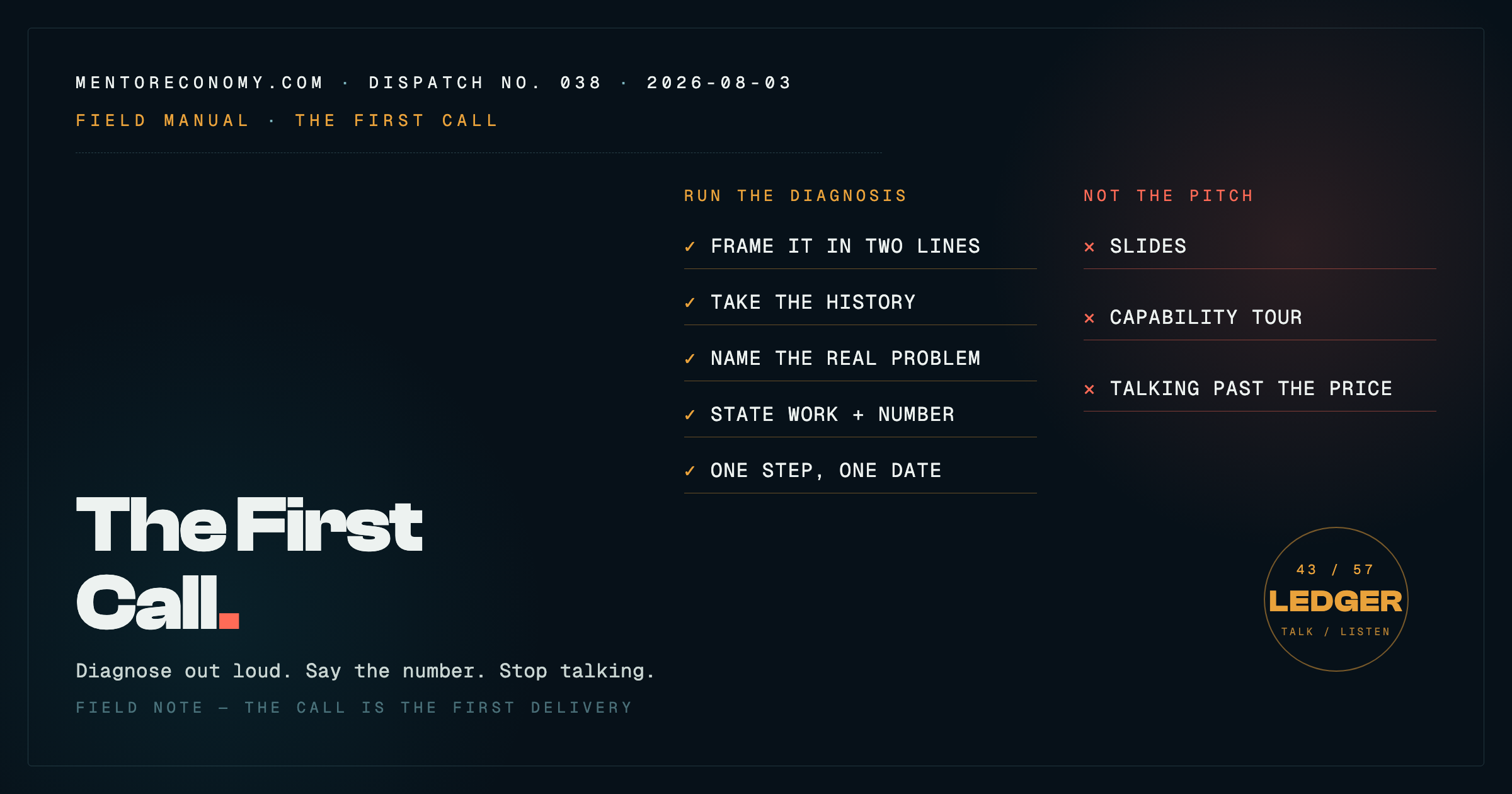
A dispatch on the single most avoided moment in independent practice.
TL;DR — the answer first: the first call is where most experienced operators lose the work, and they lose it by pitching. Twenty years of judgment gets compressed into a nervous monologue about services, because that is what selling looks like from the outside. The buyer, meanwhile, is running a different test — whether you can see their situation more clearly than they can. So run the call as a diagnosis, not a presentation: understand the problem out loud, name it more precisely than they did, state what the work is and what it costs, and stop talking. The structure is below.
The moment everything gets stuck
The outreach worked. Someone from the old network replied, or a page you published did its job, and now there is a calendar invitation for Thursday at 2:00 with a person who has a real problem and a real budget.
And a person with nineteen years of expertise spends Wednesday night making slides.
I want to be precise about why that happens, because it is not a character flaw and it is not a lack of confidence. It is a category error. Inside a company, you never had to hold both roles at once. Someone else — a partner, an account team, a brand — carried the commercial half of the conversation, and you carried the technical half. You were the person brought in to be right. On Thursday at 2:00 you are both people, and the second one has no training and no script, so the mind reaches for the only model of selling it has ever watched: explain what you offer, enthusiastically, until they agree.
That model fails here for a structural reason. The buyer already knows roughly what you do — they took the meeting. What they do not know, and what the entire call is actually about, is whether you understand their situation well enough to be trusted with it. Every minute spent describing your services is a minute not spent proving the only thing under evaluation.
What the buyer is actually testing
There is one useful outside measurement here, and it is worth stating with its limits attached.
Gong, which records and analyzes sales conversations for a living, has published an analysis drawn from over 100,000 calls. The finding: the highest performers talk about 43% of the time and listen 57%, while the average across all calls sits near 60:40 the other way. Their discovery-call material puts strong calls in a similar band, with a real question count — roughly eleven to fourteen — rather than a monologue.
Two caveats before anyone builds a practice on that. It is vendor-published data, and it comes from business software sales teams, not from solo experts selling advisory work. The absolute numbers do not transfer cleanly. But the direction does, and the direction is the opposite of what a nervous expert does on a first call. The person doing most of the talking is almost never the person who gets hired.
What replaces the talking is not passivity. RAIN Group's research on top sales performers points at something more specific: the ones who win are markedly more likely to change how the buyer thinks about their own situation. That is not listening politely. That is diagnosing out loud — which is exactly the thing a twenty-year operator can do and a well-trained junior cannot.
The truth: personalization is the product
The book states the underlying principle directly. From The Mentor Economy, Chapter Seven:
Founders personalize. A Founder does not ship the same solution to everyone. A Founder listens to one client, understands their specific context, and configures the system to fit that client's actual life. The personalization is the product.
Read that as a description of the first call and the whole thing reorganizes. If personalization is the product, then the call is not a preview of the product — the call is the first delivery of it. The buyer is not being asked to imagine what working with you would be like. They are experiencing it, in miniature, for forty-five minutes.
Which is why the pitch reads so badly. A pitch is the same for everyone; it is by definition the un-personalized artifact. Presenting one at the exact moment you are being evaluated for specificity is a contradiction the buyer feels even if they never articulate it.
The same book makes the point about Apple's education work in Chapter Five, and it is the cleanest one-line statement of the mechanism I know:
The sales were a byproduct. The loyalty was the product.
That is not a mood. It is an operating instruction for a call: do the work that produces trust, and let the transaction follow from it. It only functions, though, when what you have is genuine judgment about a narrow problem — which is the same asset I described from the credibility side in The Proof Problem. On a first call, thin judgment is exposed faster by questions than by presentations. That is a feature.
The micro-lesson: the five-part call
Small and repeatable on purpose. Every part has a job, and the parts are in this order for a reason.
- Frame it, in two sentences (minute 0). "I want to spend most of this understanding your situation. If I think I can help, I will tell you exactly what that looks like and what it costs. If I don't, I'll tell you that too, and point you somewhere better." That sentence does more work than anything else on the call. It removes the pressure dynamic the buyer was braced for, it sets the length, and it makes the possibility of a no explicit — which is the fastest way to get an honest conversation.
- Take the history (minutes 2–20). Not qualification questions. History. When did this first show up, what have you already tried, what happened when you tried it, who inside the organization disagrees about the cause. You are looking for the gap between the presenting complaint and the actual problem, because that gap is where your twenty years live.
- Name the problem (minutes 20–30). The pivot of the entire call. Say what you think is actually going on, in plain terms, including the part they did not say. If you are right, this is the moment the conversation changes character — the buyer stops evaluating and starts thinking with you. If you are wrong, they correct you and you have learned something worth more than the engagement. Both outcomes are good. Only vagueness is bad.
- State the work and the number (minutes 30–38). One shape of engagement, not three options. What you would do, in what order, over what period, ending at what. Then the price, as a sentence with a period after it. Then stop. The silence after a price is uncomfortable for exactly as long as it takes the other person to think, and filling it is the most expensive habit in independent practice. If you have not settled what the number is, settle it before the call, not during it — the reasoning is in Pricing Your Expertise.
- Close the loop (minutes 38–45). One next step with a date attached, and nothing else. Not "let me send over some materials." A specific action, owned by a specific person, by a specific day. Then end on time, even if it is going well — especially if it is going well.
Notice what is not in the list. No slides. No capability overview. No case studies unless the buyer asks, and if they ask, one, briefly, chosen because it matches what you just heard rather than because it is your best. The material you would have presented has a better home: published before the call, where a buyer inspects it on their own time. What that looks like, and why the buyer checks it long before Thursday, is in Your First Paying Mentee.
One honest limit, because a field dispatch should carry its own. This structure will not rescue a call with a buyer who has no budget, no authority, or no actual problem — and running a beautiful diagnostic conversation with someone who was never going to buy is its own kind of waste. Part of the discipline is ending early when the history stage reveals that. "I don't think this is a fit, and here is who I'd talk to instead" is a complete and professional ending to a first call, and it costs you twenty-five minutes instead of a month.
The larger reframe worth keeping: you are not learning to sell. You are learning to charge for a conversation you have been having for free, inside a company, for two decades. The conversation does not change. The last four minutes do — which is the same shift, at conversation scale, that I laid out at practice scale in Sell Judgment, Not Time.
Ledger cross-reference · The Mentor Economy, Ch. 7
The chapter behind this dispatch — why personalization is the product, and what that means for how a Founder serves one client at a time — is Chapter Seven of The Mentor Economy. Get your copy →